10.30.2006

Boo.

"Spine-tingling!" "Toe-curling!" "Keeps you on the edge of your seat!"

Apparently, watching a scary movie, as opposed to any other genre, is a very physical spectator sport. In the spirit of Halloween and with only a few more months left in the year, I just wanted to take a step back and look at some of 2006’s scary movie offerings, which is actually a fairly solid sampling of what scary movies have to offer, from atmospheric thrillers to straight-up slashers. (Note: because I haven’t yet seen Saw II, I just figured I wouldn’t understand anything in Saw III, so I haven’t seen that yet. The Saw storylines can get pretty intricate. Like Tolstoy.) In order from worst to best:

4) Texas Chainsaw Massacre: The Beginning - If you’ve already seen one of the Texas Chainsaw movies, then you know exactly what to expect when you hear they made a prequel. The movie does not offer one surprise or original idea. The filmmakers were so transparently lazy it’s almost insulting. Grainy footage! Hand-held cameras! Crazy hillbillies! Doesn’t it just feel creepy? Not quite. Oh, and memo to horror filmmakers: gore does not equal scary.

3) Final Destination 3 - Horror movies often walk a fine line between scary and funny, often by going so over the top that we're laughing at the filmmakers' audacious perversity than at the characters' misfortune. But FD3 has it all backwards. No film has made me feel older, and less funny, than the third (final?) installment in this trilogy. As Death once again comes up with creative ways to kill of a batch of teenagers (since they defied Death, he/she/it/whatever won’t stop until its mission is accomplished), I couldn’t help but feel that the filmmakers were just soulless assholes. While many horror/slasher movies could use the originality shown in FD3’s death sequences (#4, are you listening?), the writers barely take the time to think of even one personality trait per character, such as valley girl, jock, goth couple, etc. Then the filmmakers take such uninhibited, sadistic glee in dispatching them (let’s watch these bimbos fry in a tanning bed for five minutes!) that any fun is offset by the self-conscious expectation that we’re supposed to laugh and cheer along. Ugh. I know, I know. Just hand me my walker now.

2) Hostel - This movie is what we would call “progress.” The director, Eli Roth, obviously knows his shit. He knows what’s been done before and is obviously trying to tweak old stereotypes and expectations. Yes, it’s too self-aware for its own good and also relies too much on gore. But, refreshingly, it at least tries to aim higher than just sliced Achilles heels and gouged eyes. It’s suspenseful, well-paced and even fun. There is something hollow at its core, which I think is because there's no single, memorable villain in the movie. It's just Paxton (Jay Hernandez) and his buddies against a bunch of sadistic, generic Europeans. Still, it will be interesting to see what Roth does next, besides Hostel 2. And the gang of murderous kids bribed by candy? Awesome.

1) The Descent – Easily the best scary movie of 2006 (except for Little Man). This British import starring six unknown actresses may not have had the marketing hype of, say, The Grudge 2, but it surely deserved it. Six women decide to explore underground caves…and that’s as much as I’ll tell you. Yes, the symbolism of lithe young ladies trying to fit through really tight tunnels is rife for parody. But the film is so confident in its premise that it doesn’t even bother to introduce the creepy-crawly creatures that attack them until halfway through (okay, so I just told you a little more). Employing claustrophobia, smart editing, psychological mind games, complicated group dynamics and some serious ass-kicking female characters (rare indeed in Hollywood horror movies, see #4-2 above), The Descent stands out among the rest. My only problem is that the decision to trim the truly creepy, ambiguous ending from the British run for the American’s easy, lazy, cheap final scare. (For more about The Descent, its influences, references and the deal behind that truly creepy poster, click here.)

So what do these movies say about the modern state of horror movies? Sequels and prequels usually suck and there’s more crap than good ones. But you could say that about movies in general, right? Every other genre has its so-bad-its-good gems, but scary movies are consistently either genuinely great or hilariously God-awful. To paraphrase a quote, when they're good, they're great, when they're bad, they're even better. It's fun to dig through the losers even as you search for the one that truly tingles your spine.

10.16.2006

Filthy and Gorgeous

Ladies and gentlemen, break out the sequins and adjust your disco balls, because the Scissor Sisters are back.

Exploding onto the UK charts two years ago with their self-titled debut full of catchy glam-pop, the Sisters found middling success here in the States, where the airwaves are dominated by rigidly masculine rock and hip-hop. This, of course, was exactly why they were such a welcome distraction from the generic, marginally talented acts showcased on TV and radio. Scissor Sisters was packed with intelligent, hilarious, dirty anthems that transcended the narrow, if slightly accurate, defintion of "disco."

Which is why, at first, I was slightly disappointed with Ta-Dah, their second CD. The songs didn’t seem to pop the way they had on SS’ debut. On that album, the aural assault of opener “Laura” segued into the fizzy guitars of “Take Your Momma Out” which floated into the spacey falsettos of the Led Zeppelin cover, “Comfortably Numb.” On Ta-Dah, the contrasts might not always be as sharp, but repeated listening reveals lyrics that are at turns hilarious and haunting and musical influences ranging from barbershop quartets to cheesy rock musicals.

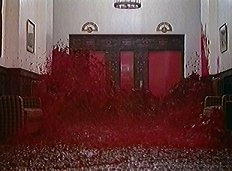
They embody a rebellious, pan-sexual decadance, with a wit so often spiked with arsenic. "I Can't Decide" is a perky confession of murderous intentions that are only resisted because Jake Shears, the band's lead singer and co-writer, is convinced he'll be killed in retaliation if he fails. On "Intermission," Shears sounds like he should be doing soft-shoe with a hat and cane while blithely tossing off lines like "Happy yesterday to all/We were born to die." (The CD cover should have tipped me off to the madcap darkness inside. It recalls imagery from both ends of 80’s horror: the exalted classic The Shining [think of the elevator scene] and the cheesy, low-budget April Fool’s Day.)

Don't get me wrong - the Sisters still like to party. It's hard to deny the ecstatic power once Shears' voice soars halfway through the chorus of "Lights," and "Kiss You Off" may simply be one of the most fun songs ever about kicking out an inadequate lover using an extended cosmetic metaphor. If you learn the brilliant lyrics to the rollicking chorus, you'll definitely win karoake night.

The party theme continues behind the scenes as well, with Elton John co-writing and playing piano on two songs and none other than Miss Cristal Conners herself, Gina Gershon, playing harp on "I Can't Decide" (that was a very weird sentence to write).

But I also can't emphasize enough the intelligent, thoughtful craft behind their more introspective songs. Like how the rambling, meandering verse on "Might Tell You Tonight" recreates a giddy, nervous, stream-of-conscious confession of love. "The Other Side" is a prayer from one dying lover to another ("I'll count our blessings as I/wait for you, on the other side") and the pauses in the verse echo real-life silences in hospital rooms.

I feel somewhat guilty enjoying the fruits of Shears and Co.’s misery, but when it produces such lyrics as “If lies were cats you’d be a litter,” how could I not? In fact, in only twelve songs amounting to forty-five minutes, the sonic champagne of Ta-Dah proves that the Scissor Sisters may be one of the best, most consistent bands at constructing perfect pop songs.

10.10.2006

Trim the Sentence About the Female Orgasm and I'll Get an "R"

You know how, once you're old enough, you stop paying attention to movie ratings? If it's a family film, you know it's G or PG. If it's a somewhat mild [teen/romantic/misc.] comedy, then it's a PG-13. Anything else is R, and the rare occassion of an NC-17 usually means a lot of sex. In fact, unless you have kids, the only time the ratings mean anything to you is when you want to avoid a G or PG or even a PG-13, to avoid anything too schmaltzy and wholesome (i.e. boring and predictable).

Well, what about the people who decide on those ratings to begin with? Who are they? How do they make their decisions? This Film is Not Yet Rated only finds out the answers for the first two questions, not the third. Directed by Kirby Dick, this documentary is meant to expose mainstream audiences to the hypocritical, unaccountable mess that is the Motion Picture Association of America.

To do this, Dick interviews directors who have had problems with the MPAA. Kimberly Pierce, the director of Boys Don't Cry, had to trim a scene that focused on one of her female characters experiencing an orgasm. She didn't have to cut the scene entirely, but for the film to go from an NC-17 to an R, she had shave a few seconds off. Director John Waters has also, unsurprisingly, had problems getting some of his material pass the MPAA with anything under an NC-17. Matt Stone, one of the writers of Team America: World Police, explains how they intentionally filmed much more of their puppet sex scene than they planned to use just so they could dupe the MPAA into believing they trimmed NC-17 material for an R rating. And it worked.

Why all this effort to avoid an NC-17 rating anyway? Because many newspapers won't carry ads for NC-17/unrated movies (it's not required to even get a rating in the first place), many movie theaters won't show them, and Blockbuster and Wal-Mart won't carry those movies, which accounts for a large percent of the video market. Basically, a film cannot be NC-17/unrated if it wants distribution, marketing and, ultimately, an audience.

It's during this educational portion of the doc that we learn about the MPAA's double standards. Violence is much more tolerable than sex, straight sex is better than "abnormal" (read: gay) sex, and major studios get away with more than indie films. Want to discuss these biases with an actual rater? Good luck. All the members of the MPAA ratings board are kept anonymous so that they don't have to explain their decisions and so that people don't "pressure" them. Seriously.

Who do they think they are? Why are these raters treated like children who must be protected from the big, bad public (ironically, the very public they claim to be protecting with their ratings)? Every single other person has to be accountable for their decisions on their job (well, I can think of one guy who isn't, but we won't go there). Every single other person has to deal with "pressure" if they make a decision that other people might not agree with. Are these raters so fragile that they can't assert their opinion at a dinner party or, even better, assert that they don't care to discuss their decisions at all? How difficult is that? It's called coping, people. Better yet, it's call adulthood.

Of course, if a filmmaker disagrees with a rating, they can appeal. This is done behind closed doors, with an anonymous appeal panel, and the filmmaker is absolutely not allowed to reference other, similar films to put his own in context. Dick manages to talk to two former members of the appeals board, one anonymous, one not. They both explain that there are two religious figures on the appeals board (two priests of different denominations) (and, oh yeah, um, what?), but the anonymous one claims that these religious guys vote, while the identified one claims they don't - can you say "plant"?

Dick also spends time with the plucky private detective Becky Altringer to hunt down the members of the MPAA. They are successful in finding the identities of almost every member of the ratings and the appeals board. Unsurprisingly, their statistics contradict the MPAA's publicized profile of a typical rater. Instead of having children between the ages of 3 and 19, most of their children are in their 20's and 30's (all the are heterosexual parents). Instead of only serving for at maximum nine years, most have been on the board much longer. Although Dick discloses all their identities, it's not exactly clear what to do with this information. Quickly write it down and harass the raters? Write Dick an email congratulating him? I think Dick expexts the audience to share the exhilerating, David-vs.-Goliath pride he revels in, but that "stick it to the man" rush doesn't last long.

Though flawed in its allotment of information, the film provokes much anger against an entity that coddles its members while infantilizing the American public. Fittingly, this film actually is not rated. Dick originally received an NC-17 rating due to using examples from NC-17 films (even the film's posters shown here have been banned in some areas). So, after unsucessfully appealing, he decided to go without a rating at all. That's his choice as an artist, of course - it's not as if the MPAA wants to censor anyone - but that also means it will be very hard to see this film in the theaters. That's not actually a big loss, as it doesn't benefit from the big screen. Since the film is produced by IFC and in this Netflix age, you should be able to find it soon.

And when you do, don't pay any attention to the (lack of a) rating.

10.01.2006

What Do I Call Her If I'm Not Nasty?

(Blogger's note: This post was chosen by Blogcritics as an Editor's Pick of the Week, 10/4-10/10. Assistant Music Editor A.L. Harper said: "Janet Jackson still talks to my naughty side and Don Baiocchi knows it. His review of Jackson's latest album, 20 Y.O., convinced me to buy the album and I love it!" I can feel the power coursing through my critic-veins as we speak. Thanks, A.L.!)

It was twenty years ago that Janet Jackson broke out onto the pop and R&B charts with Control, a defiant independence anthem that paved the way for the culture warrior she embodied in 1989's Rhythm Nation 1814. Those two blockbuster albums barely hinted at the nymph beneath the armor, and soon their angular, industrial beats were replaced by a softer, warmer sound on 1993's janet. Emerging like a gym-toned Venus on the cover of Rolling Stone, Janet announced that, at 27, the shy pop star of "Let's Wait Awhile" had found her G-spot.

It's been a bumpy road since that hit-machine triumvirate for Ms. Jackson, with sales declining even before the infamous wardrobe malfunction. Each successive album has had at least one great single ("Together Again," "All for You," "I Want You"), but after 2004's disappointing, sex-drenched Damita Jo, Janet (and her record label) seem eager to remind people why she's still around.

Which leads to 20 Y.O., her ninth album. The title is a reference to both how old she feels (with a body to match) and to her breakthrough in 1986. The album is at odds with itself, trying to reclaim the dance hits of the 80's and 90's without losing the liquid R&B of her more recent albums, all while trying to create a modern sound to attract new fans without alienating long-term fanatics. Whew. That's a lot of pressure to put on eleven songs.

And Janet is responding to that pressure by having nothing but fun. No angst, no anger, no nasty boys or son-of-a-guns to piss her off, which is strange, since Control was all about asserting herself. "I want to keep it light, I don't want to be serious. I want to have fun," she says in the opening spoken interlude. OK, fine, that sounds good, but then how is this a throwback to...oh, nevermind. The first half of 20 Y.O. is a five-song suite that blatantly tries to put Janet back in the dance clubs where she belongs. The album lead-off and second single, "So Excited," isn't the flawless dancefloor anthem fans were hoping for in the tradition of "If" or "Miss You Much." On any other Janet album, it would be a good 3rd or 4th single, but the breathy vocals and monotone chorus are way too laid back to create any urgent excitement promised by the title.

The one-two punch of "Get It Out Me" and "Do It 2 Me" are where the album really takes off, and either song would have made a much better lead single to announce that Janet's back, she's having fun and she's ready to dance. Her whispery coo is just one of two or three vocal personas that Janet pulls out on the former in a three-minute kitchen-sink anthem praising the mysterious skills of her lover, and while it may be trying too hard, I'd rather see Janet work her ass off to please her audience than coast on her charms.

The second half downshifts into "break it down" mode, with gauzy ballads and mid-tempo "Escapade" throwbacks that are much better than those descriptions would imply. This is where this album accomplishes what it set out to do. "With U" (aren't her U's and 2's so endearingly dorky at this point?) is a stripped-down ballad that recalls the forgotten beauty of 1990's "Come Back to Me" with a modern sound that Mariah should be jealous of. "Daybreak" and "Enjoy" are smooth, sweet trifles, complete with carnival charms, sing-along melodies and even a children's chorus in the latter.

The last two songs continue Janet's tradition of baby-making music. From "Let's Wait Awhile" to "Someday Is Tonight" to "Anytime, Anyplace" to "Rope Burn," Janet's sexual evolution has been a thoughtful, fascinating one, especially compared to the one-dimensional skankocity of many poptarts these days. Unfortunately, Damita Jo's "Warmth" and "Moist" were basically audio porn that brought Janet to a completely unsexy dead-end. Luckily, someone must have told her that less is more. "Take Care" and "Love 2 Love" are carefully crafted and reward repeat listenings. Especially "Love 2 Love," with Janet's jazzy vocals, pelvis-thumping bass bumps and second-verse beat break that add up to one of the most original sexy songs in the pop landscape right now. Cut it by a minute for a radio edit, throw it on commercial radio around 1am, and couples will be pulling over to see how far back their car seats decline.

The album isn't without its faults. The spoken interludes, a trademark of Janet albums, distract from what Janet's accomplishing now by insistingly (and ineffectively) reminding us of what she's done in the past, all while being the exact same interludes we've heard from her before (rain, inside jokes with her dancers, sexy phone calls, etc.). And while Janet doesn't have a powerhouse voice by any means, she still full-out sang on past hits like "Love Will Never Do (Without You)" and "All for You." The airy whisper that she now employs by default (such as on the entire Damita Jo album) is just plain annoying and detracts from her songs. Luckily, she doesn't indulge such laziness as much this time around.

Unfortunately, the marketing of this album makes no sense. It's a desperate combination of "I made a great album twenty years ago!" and "I want to be a stripper!" For the woman who made 1997's The Velvet Rope, a smart, dark, challenging album that no other contemporary pop star would dare to make even if they were could, this current direction is a little disappointing. Especially since it doesn't have all that much to do with the album, which is a celebration of a confident woman happily in love. And to kick off a comeback with the mediocre "Call On Me," a duet where she actually makes Nelly sing, is just plain wrong. Since she's basically banned on MTV after the Super Bowl incident (since, you know, MTV has such strict standards on how much skin its stars should expose), Janet needed something much stronger to break her way back into mainstream media besides a US Weekly cover touting her recent wait loss. "Call On Me" wasn't the way to do that, and "So Excited" didn't pick up the slack.

Marketing aside, Janet's crack production team of Jimmy Jam and Terry Lewis are joined by her producer boyfriend Jermaine Dupri (who also helped orchestrate Mariah's comeback with The Emancipation of Mimi), and all are on their game here...for the most part. Certain details like the tinny hand claps in "Call On Me" are bizarre missteps, but most of their sonic creations, like the slinky electro-funk of "This Body," ensure that Janet is doing something different from her younger contemporaries and doing it well.

For all of its bump 'n grind aspirations, 20 Y.O. never fully merges the contradicting needs of Janet's smooth R&B and sharp dance-floor pop. Whether it pleases her legion of diehard fans while convincing the younger set who don't even remember Control to buy her album remains to be seen. The point is, Janet sounds as self-assured, sexy and relaxed as ever. While there may be no signature single like "Rhythm Nation" or "That's the Way Love Goes," this album has multiple singles ready to climb their way onto radio and up the charts. We'll see if a forty-year-old pop star (supposedly) free of neurosis can achieve what her assertive twenty-year-old self did two decades ago.